

Summary
- The Problem: The “cult problem” is fundamentally a people problem, not an organisational one. As posited by Paul S. Waugh society suffers from a pervasive “cultee mentality”—an endemic tendency towards uncritical acceptance, conformity, and the absence of genuine questioning—which makes individuals vulnerable to coercive control in any context, not just within groups labelled as “cults”.
- The Root Cause: This cultee mentality is fostered through indoctrination in families, educational institutions, workplaces, and by trusted authorities like mainstream media. From birth, people are conditioned to obey without question, eroding their capacity for honest, humble inquiry and critical thinking.
- The Distinction: Healthy obedience to God is grounded in freedom, love, and conscience, nurturing moral agency and genuine relationship. In contrast, tyrannical obedience demanded by human authorities relies on fear, manipulation, and the suppression of individual conscience, leading to psychological captivity.
- The Institutional Failures: Self-proclaimed cult experts like Alexandra Stein and mainstream media outlets like the BBC exemplify the problem by focusing narrowly on fringe groups whilst ignoring or enabling coercive control within mainstream institutions. The BBC’s handling of cases like “A Very British Cult” demonstrates how media authority can protect abusive families and silence victims, mirroring the very dynamics they claim to expose.
- The Solution: Society must cultivate a culture of humble, critical inquiry rather than cynical doubt or blind conformity. Genuine protection of the vulnerable requires consistent standards of evidence and accountability applied fairly across all contexts—not the weaponisation of the “cult” label to silence dissent or reinforce establishment narratives
Table of Contents
You Are A Cultee In The Invisible Cult Of Modern Life: Indoctrination, Conformity & Coercive Control
1. Introduction
1.1 The Cult Problem Is Primarily a People Problem
1.2 Toxic Groups, Organisations and Abusive Cults Are a Genuine Problem To Be Solved
1.3 The Label of ‘Cult’ Is Being Abused As a Slur To Destroy Perceived Enemies
1.4 The Case of Alexandra Stein: Labels and Allegations Without Investigation
2. From Cults to ‘Cultees’: Paul S. Waugh’s Analysis
2.1 Defining and Explaining The ‘Cultee’
2.2 The People Who Enter Destructive Cults and Those Who Don’t
2.3 The Real Danger When It Comes To Cults
3. Healthy Obedience to God vs. Unhealthy Indoctrinated Obedience to Tyrants
3.1 Biblical Obedience: Freedom, Love, and Conscience
3.1.1 The Nature of Tyrannical Obedience
3.1.2 God’s Authority vs. Human Authority: The Test of Conscience
3.1.3 Obedience as Formation, Not Indoctrination
3.1.4 The Danger of Confusing the Two
3.1.5 Conclusion: Reclaiming Healthy Obedience
4. The Psychology of Conformity: Asch, Milgram, and the Mechanisms of Indoctrination
4.1 Classic Experiments in Social Conformity
4.2 Neuroscience and Social Influence
5. Indoctrination, Education, and the Erosion of Critical Thinking
5.1 Indoctrination in Educational Systems
5.2 The Loss of Genuine, Non-Cynical Questioning
6. Coercive Control Beyond Cults: Families, Workplaces, and Institutions
6.1 Coercive Control as a Social Phenomenon
6.2 Socialisation, Identity, and Conformity
7. The Universal ‘Cultee’: Why Everyone is Susceptible
7.1 The Conditioning Process: From Birth to Adulthood
7.2 The Invisible Cult of Everyday Life
7.3 Recognising One’s Own ‘Cultee’ Mentality
8. Alexandra Stein: Focusing on Cults, Not the Underlying People Problem
8.1 Refusal to Investigate and Endorsement Concerns
8.1.1 Refusal to Conduct Independent Investigation
8.1.2 Endorsement of Accused Abusers
8.1.3 Religious Hate Speech Allegations
8.1.4 The Implication for Abuse Survivors
8.2 Summary of the Stein Critique
9. The British Broadcasting Corporation (BBC): The Mainstream ‘Cult’?
9.1 Trust, Authority, and Unquestioned Belief
9.2 The ‘Cult’ of Media Authority
9.3 Catrin Nye and A Very British Cult: Protecting Abusive Families, Blaming the Victims’ Support Network
9.3.1 The Deception: “Someone Known to the Family”
9.3.2 The Real Cult: Erin’s Family
9.3.3 Catrin Nye’s Role: Protecting Abusers, Attacking Supporters
9.3.4 The Jimmy Savile Cover-Up: Institutional Protectionism and the Suppression of Truth
9.3.5 A Pattern of Harming Abuse Survivors
9.3.6 Paul Waugh’s Challenge: A Live, Public Interview
9.3.7 Media as Enabler of Family Cults
10. Conclusion: Toward a Culture of Humble, Critical Inquiry
References
1. Introduction
1.1 The Cult Problem Is Primarily a People Problem
Paul S. Waugh‘s assertion that “The cult problem is not primarily a group or organisational problem, it’s a people problem” provides a crucial lens for understanding the roots of cultic influence and coercive control. Waugh’s perspective is that the real danger does not lie in the existence of cults as organisations, but in the widespread human tendency towards uncritical acceptance, conformity, and a lack of genuine questioning. He emphasises that ‘cultee’ mentality—defined as the willingness to accept beliefs, authority, or group norms without critical scrutiny—is endemic throughout society, not just within fringe groups. Or there are fringe groups falsely labelled as dangerous simply because they are different, untraditional or unconventional. This mentality is fostered in families, institutions, religious organisations, and especially by trusted authorities such as the mainstream media, including the BBC. The result is that people become vulnerable to manipulation and coercive control in any context, not just those labelled as ‘cults'[1].
Paul S. Waugh’s analysis highlights that the failure to cultivate honest, humble questioning—rather than cynical or reactionary doubt—is what enables coercive dynamics to flourish. The focus on cults as discrete entities distracts from the broader, more pervasive issue: the indoctrination of conformity and obedience in ordinary social structures. This context is essential for evaluating the limitations of mainstream cult discourse and the work of self-proclaimed cult experts.
1.2 Toxic Groups, Organisations and Abusive Cults Are a Genuine Problem To Be Solved
Waugh crucially acknowledges that genuinely toxic groups, organisations, and actual cults that engage in systematic abuse, manipulation, and coercive control must be identified, held accountable, and, where they refuse to reform, shut down. The protection of vulnerable individuals in vulnerable circumstances from predatory systems is a legitimate and necessary function of civil society, law enforcement, and ethical journalism.
1.3 The Label of ‘Cult’ Is Being Abused As a Slur To Destroy Perceived Enemies
However, this legitimate concern must not be weaponised as an ideological tool to destroy perceived enemies who simply hold vastly different beliefs or challenge dominant narratives. The designation ‘cult’ carries immense social, legal, and reputational consequences. When applied carelessly, vindictively, or without rigorous investigation, it becomes a means of silencing dissent, marginalising unconventional communities, and reinforcing the very conformity and unquestioning obedience that Waugh critiques.
Lighthouse Global’s critique of the BBC exemplifies this danger in reverse: a politically and culturally conservative organisation alleging that a left-wing, institutionally powerful broadcaster has abused the ‘cult’ label to suppress alternative perspectives and protect abusive families whose narratives align with establishment interests. Whether one agrees with Lighthouse’s theological, political, or organisational model, the principle remains: the language of ‘cult’ and ‘coercive control’ must be applied with intellectual honesty, rigorous evidence, and genuine concern for truth and victims—not as a rhetorical weapon to destroy ideological opponents.
The test of integrity in addressing cults and coercive control is not whether one’s targets are popular or unpopular, mainstream or fringe, but whether the standards of evidence, investigation, and accountability are applied consistently and fairly. To do otherwise is to perpetuate the very ‘cultee mentality’ this report seeks to expose: the uncritical acceptance of authority, the demonisation of outsiders, and the suppression of genuine inquiry in the service of institutional power.
But focusing purely on negative and toxic cults removes the critical thinking aspect that we need to acknowledge about cultee mindsets in other parts of society, not just negative and toxic cults. It is not a behaviour that is present in just one facet.
1.4 The Case of Alexandra Stein: Labels and Allegations Without Investigation
The case of Alexandra Stein illustrates the limitations of focusing solely on cults as organisational pathologies. Despite her claimed expertise, Stein is accused of labelling Lighthouse Global a cult without conducting independent investigation, refusing multiple invitations to meet with Paul Waugh or Lighthouse members, and publicly endorsing individuals accused of serious child abuse—including appearing on media platforms with parents whose adult children allege lifelong maltreatment and coercive control.
These allegations raise profound questions about the responsibilities of so-called cult experts when family dynamics and historical abuse are involved. By dismissing Lighthouse without hearing from alleged abuse survivors within the community, Alexandra Stein is accused of effectively siding with abusive families seeking to reclaim control over their adult children. This approach, Lighthouse argues, exemplifies the very ‘cultee mentality’ Paul S. Waugh critiques: accepting accusations without question, deferring to institutional authority (the Daily Mail, established ‘experts’), and failing to investigate independently.
The dominant public discourse often frames ‘cults’ as the central danger to individual autonomy and healthy scepticism. However, a deeper examination—supported by academic research, psychological experiments, and the insights of Paul S. Waugh—suggests the bigger threat is not cults per se, but the widespread phenomenon of indoctrinated, uncritical acceptance and conformity that leaves people vulnerable to coercive control in all spheres of life: families, governments, media, workplaces, and social circles. The cult problem is indeed a people problem. This report synthesises psychological, sociological, and philosophical research to argue that the root problem is a pervasive culture of conformity and unquestioned trust in authority, with the BBC serving as a salient case study as detailed below.

2. From Cults to ‘Cultees’: Paul S. Waugh’s Analysis
2.1 Defining and Explaining The ‘Cultee’
Paul S. Waugh, in his reflections on cults and ‘cultees’, argues that the societal focus on cults is misplaced. He defines a ‘cultee’ as someone who accepts things without question, highlighting that this mentality is far more prevalent and insidious than the existence of cults themselves. Waugh contends that society is rife with ‘cultee behaviour’ — the tendency to accept beliefs, norms, or authorities uncritically. He asserts that the true problem is not primarily the cult, but the ‘cultee mentality’: an indoctrinated unwillingness to ask fundamental, open, and honest questions about core beliefs and sources of authority. This mentality, he warns, makes individuals and entire societies susceptible to manipulation and coercive control, regardless of whether the context is a formal cult or mainstream institution[1].
2.2 The People Who Enter Destructive Cults and Those Who Don’t
People who are critical thinkers, with healthy scepticism and intellectual rigour, do not enter negative destructive cults. People who enter negative destructive cults come from negative cults, whether that is their family, school, social group, religion or religious denomination. They come from a toxic group so they feel they fit in with a toxic group. So in reality they don’t suddenly become cultees by entering a cult, they enter a cult because they are already cultees in the way they see, think, feel and act. No one in their right mind who isn’t a cultee would enter a cult.
Crucially, Waugh distinguishes between cults as organisations and the ‘cultee mentality’ that pervades society. He argues that cults create a dependent environment that ‘cultees’—individuals who lack an inquiring mind, a searching heart, or an adventurous spirit—to the degree they do, are drawn to. According to Waugh, this cultee mentality is not confined to recognised cult members; rather, it characterises anyone who has been conditioned that way by family, schooling, and social institutions to accept external authority without internal reflection or inquiry. The cultee mentality manifests through high levels of fostered dependency as an absence of genuine curiosity and critical thinking: “You don’t have to be a member of a cult to be a cultee in the way your modus operandi plays out.” This indoctrination limits human beings from their own understanding and inquiry into their own souls, creating a focus on external validation and control rather than internal development and autonomy.
2.3 The Real Danger When It Comes To Cults
Paul S. Waugh’s argument fundamentally reframes the cult debate: the real danger is not primarily cults as organisations, but rather the universal human susceptibility to uncritical conformity and unquestioning obedience to authority. Waugh observes that people are systematically “set up to limit their life” through socialisation processes that suppress independent inquiry and authentic self-development—a form of “suicide-by-instalments” that can manifest as anything from mindless consumption of entertainment to substance abuse or simply living without meaning, purpose or questioning.
Waugh emphasises the importance of genuine, humble questioning—not cynical or reactionary doubt, but a deep, sincere inquiry into what is true, healthy, and meaningful. He warns against the pride and ignorance that come from refusing to be wrong, seeing this as the true root of cult-like behaviour in society. His analysis is particularly critical of those who accept the pronouncements of major institutions like the BBC without scrutiny, likening this uncritical trust to cult membership itself[1].
In the same way that one can be a footballer without belonging to a football team, or be religious without belonging to a church, one can be a cultee without belonging to a cult. It is a mentality, Waugh argues, that arises from adopting a mode of behaviour that is predominantly uncritical and submissive toward authority or social pressure.

3. Healthy Obedience to God vs. Unhealthy Indoctrinated Obedience to Tyrants
A critical distinction must be made between genuine, healthy obedience to God—as understood in authentic religious tradition—and the coercive, indoctrinated obedience demanded by human tyrants, whether they operate within cults, families, institutions, or governments. This distinction is essential for understanding how true faith differs fundamentally from cultee mentality.
3.1 Biblical Obedience: Freedom, Love, and Conscience
In Christian theology, obedience to God is presented not as blind submission, but as a voluntary response to divine love, truth, and goodness. The Bible repeatedly emphasises that God desires hearts that freely choose righteousness, not robots programmed for compliance. Jesus Christ commanded his followers to “love the Lord your God with all your heart and with all your soul and with all your mind” (Matthew 22:37), positioning love—not fear—as the foundation of obedience.
Moreover, biblical obedience is inseparable from the cultivation of conscience and discernment. Believers are commanded to “test everything; hold fast what is good” (1 Thessalonians 5:21) and to be “transformed by the renewal of your mind, that by testing you may discern what is the will of God” (Romans 12:2). This is the opposite of cultee mentality: Scripture actively encourages critical inquiry, personal responsibility, and the development of moral and spiritual discernment.
The Apostle Paul praised the Bereans for examining his teaching against Scripture rather than accepting it uncritically: “they received the word with all eagerness, examining the Scriptures daily to see if these things were so” (Acts 17:11). Healthy obedience to God, therefore, involves active engagement, questioning, and verification—not passive acceptance.
3.1.1 The Nature of Tyrannical Obedience
In contrast, obedience demanded by human tyrants—whether in cults, abusive families, authoritarian regimes (even when masquerading as democratic ones!), or coercive institutions—is characterised by fear, manipulation, and the suppression of conscience. Tyrants demand compliance without question, punish dissent, isolate followers from alternative perspectives, and cultivate dependency and shame to maintain control.
This form of obedience is rooted in coercion, not love. It exploits human vulnerabilities—fear of rejection, a need for belonging, the desire for certainty—to short-circuit independent thought and moral agency. The tyrant positions himself as the sole source of truth, safety, and value, demanding total loyalty and forbidding any appeal to higher principles or external verification.
Crucially, tyrannical obedience is enforced through the cultee mentality: followers are conditioned to accept the leader’s authority without scrutiny, to suppress their own doubts and questions, and to view dissent as betrayal. This dynamic can occur in recognised cults, but it is equally present in families where parents demand unquestioning submission, in workplaces where managers punish independent thinking, and in institutions—including religious ones—where established hierarchy is used to silence conscience.
3.1.2 God’s Authority vs. Human Authority: The Test of Conscience
The decisive test between healthy obedience to God and unhealthy submission to tyrants lies in the role of conscience and truth. God’s authority, as revealed in Scripture and Christian tradition, is presented as inherently aligned with truth, justice, love, and the flourishing of the human person. When human authorities command actions that violate conscience, Scripture is unequivocal: “We must obey God rather than men” (Acts 5:29).
In the Christian context, the definition of a cult rests primarily on the teachings of an institution, church, or group rather than on any external characteristics identified by so-called cult experts. Recognising that all human beings are fallible and sinful, the essential test becomes one of conscience: is this group seeking to obey what is written in the Bible the best they can, or not?[15] Do they embrace Christ’s deity and sacrifice for sins, or not? Do they know that salvation is by grace alone, or not? Future reports and writings by Paul S. Waugh and his support team will explore this in more detail.
This principle establishes a hierarchy of authority in which God’s law—understood through reason, conscience, and revelation—stands above all human commands. Healthy religious obedience, therefore, is never truly blind. By contrast, tyrants demand absolute obedience and reject any appeal to conscience, higher law, or external accountability. They present themselves as the ultimate authority, brooking no dissent and no competing loyalties. This inversion of the proper order—placing human authority above God and conscience—is the hallmark of coercive control and the cultee mentality which is prevalent throughout much of the secular system.
3.1.3 Obedience as Formation, Not Indoctrination
Authentic religious obedience serves the purpose of formation: the gradual development of virtue, wisdom, and spiritual maturity. It is a pedagogy of freedom, in which external guidance and discipline are meant to cultivate internal self-governance and moral autonomy. The goal is not perpetual dependence, but the development of a mature, free person capable of discerning and choosing the good independently, in accordance with universal truths and principles as endowed by our Creator.
This contrasts sharply with indoctrination, which seeks to produce permanent dependence and suppress autonomy. Indoctrination replaces the development of conscience with the imposition of dogma; it replaces the cultivation of virtue with the enforcement of compliance. The indoctrinated person does not grow in freedom or understanding; they remain perpetually childlike, unable to think, judge, or act independently.
3.1.4 The Danger of Confusing the Two
One of the greatest dangers in contemporary discourse is the tendency to conflate all forms of obedience, treating religious obedience to God as equivalent to coercive submission to human authorities. This conflation serves the interests of tyrants, who exploit religious language and imagery to legitimise their control, whilst simultaneously undermining authentic faith by associating it with cultee behaviour.
Paul S. Waugh’s analysis helps clarify this confusion: the problem is not obedience per se, but the cultee mentality that accepts authority without discernment. Healthy obedience to God is the opposite of cultee mentality; it requires constant inquiry, moral courage, and the willingness to stand against human authorities when they contradict divine truth and justice.
Conversely, those who reject all forms of obedience in the name of individual autonomy often fall into a different form of cultee behaviour: unquestioning obedience to secular authorities, cultural norms, or their own unchallenged desires. True freedom lies not in the rejection of all authority, but in the discernment of legitimate authority—rooted in truth, love, and the dignity of the human person—and the courageous rejection of tyranny in all its forms.
3.1.5 Conclusion: Reclaiming Healthy Obedience
The distinction between healthy obedience to God and unhealthy submission to tyrants is not merely theological; it is essential for understanding and resisting coercive control in all its manifestations. Authentic religious obedience cultivates freedom, conscience, and moral agency; tyrannical obedience suppresses them. The former is a path to human flourishing and genuine autonomy; the latter is a mechanism of enslavement.
Recognising this distinction requires intellectual humility and moral courage—the willingness to question one’s own assumptions, to examine the sources of one’s beliefs and loyalties, and to prioritise truth and conscience over comfort and conformity. It requires, in Waugh’s terms, the rejection of the cultee mentality and the cultivation of an inquiring mind, a searching heart, and an adventurous spirit grounded in love of truth and neighbour.
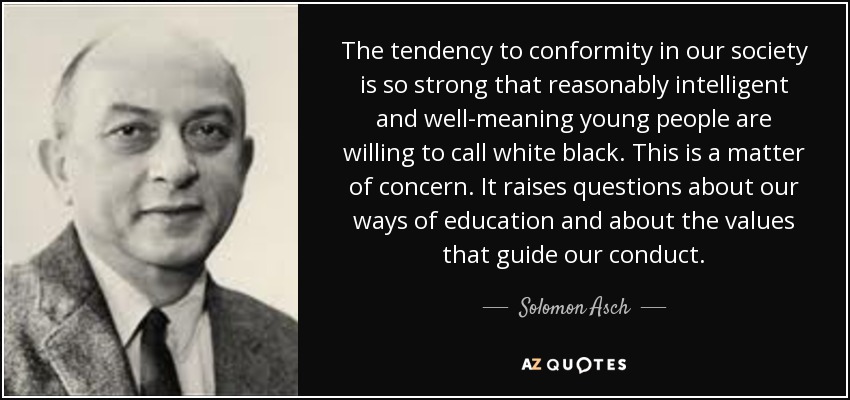
4. The Psychology of Conformity: Asch, Milgram, and the Mechanisms of Indoctrination
4.1 Classic Experiments in Social Conformity
Decades of psychological research have demonstrated the power of social pressure to override individual judgment. Solomon Asch’s conformity experiments in the 1950s showed that individuals would knowingly give wrong answers to simple perceptual tasks if the majority of a group did so first. About a third of participants conformed to the group’s incorrect consensus, even when the answer was obviously wrong[2][3][4][5]. This effect—now known as the “Asch effect”—demonstrates that the desire for social acceptance and fear of standing out can suppress independent judgment.
Take, for instance, Waugh’s example of how children can be shamed for wearing the wrong or different school uniform from their peers, and how deeply upsetting and traumatising that can be for a child conditioned to seek belonging and acceptance—often without understanding what they are conforming to or why. These seemingly mundane examples reveal how a ‘cultee’ mentality of conformity can be adopted from a young age and reinforced through everyday social circumstances.
4.2 Neuroscience and Social Influence
Recent neuroscience research confirms that conformity is not merely a social phenomenon, but is rooted in brain mechanisms that process social feedback and punishment. The desire to avoid social rejection and the neural rewards of group belonging can override rational analysis and critical thinking[6]. This biological basis helps explain why indoctrination and conformity are so pervasive and difficult to resist, even among highly educated individuals. To mistake this social phenomenon as purely, or more acutely, present in fringe groups—whether they are negative toxic cults or simply different or unconventional—is to completely miss a core characteristic of how humans interact with one another in every facet and form of organisation and institution.
5. Indoctrination, Education, and the Erosion of Critical Thinking
5.1 Indoctrination in Educational Systems
Academic research has documented how educational systems can foster indoctrination by emphasising obedience, rote learning, and uncritical acceptance of authority. Studies of communist-era Poland, for example, found that political indoctrination in schools suppressed critical thinking and agency, with long-lasting negative effects on human capital and civic engagement. Even in democratic societies, education often balances the goal of fostering critical thinking with the competing aim of instilling collective identity and allegiance, sometimes at the expense of open-minded inquiry.
5.2 The Loss of Genuine, Non-Cynical Questioning
Research suggests that the loss of genuine, healthy scepticism is linked to educational, familial, and cultural practices that reward compliance and penalise dissent. Over time, individuals internalise the belief that questioning is dangerous, futile, or socially costly, leading to a chronic state of epistemic passivity. This is not just a cognitive deficit, but an emotional and social one, as the need for belonging and fear of ostracism reinforce conformity.
6. Coercive Control Beyond Cults: Families, Workplaces, and Institutions
6.1 Coercive Control as a Social Phenomenon
The concept of ‘coercive control’—originally developed to describe patterns of abuse in intimate relationships—has been extended by researchers to encompass a wide range of social contexts, including families, workplaces, and institutions. Coercive control involves sustained patterns of manipulation, isolation, surveillance, and psychological abuse designed to erode autonomy and enforce compliance.
6.2 Socialisation, Identity, and Conformity
Research on doctoral education and professional socialisation reveals that even highly trained individuals can become ‘socialised’ into uncritical acceptance of institutional norms and expectations[7][8]. The process of becoming a ‘good’ member of a profession or community often involves the suppression of dissent and the internalisation of dominant paradigms, further illustrating that cult-like indoctrination is a feature of mainstream society, not just its fringes.
There is no organisation, family, or social structure that, by having patterns of socialisation and conformity—the rules of what to do and what not to do—is not cult-like to some degree. Even in the most destructive cults, there are positive elements to be found; and within the healthiest environments, there are inevitably cult-like tendencies. Nothing is entirely good or entirely bad—that is simply not reality. This is why critical thinking is essential: to accurately and carefully discern what needs to be challenged and changed, and what can rightly be retained.
7. The Universal ‘Cultee’: Why Everyone is Susceptible
Paul S. Waugh’s concept of the ‘cultee’ mentality extends beyond those formally involved in groups labelled as cults. His central insight is that everyone—regardless of education, intelligence, or social status—carries within them the susceptibility to uncritical acceptance, conformity, and deference to authority. This is not a moral failing or a sign of weakness; it is the inevitable result of systematic conditioning that begins in childhood and continues throughout life.
7.1 The Conditioning Process: From Birth to Adulthood
From the earliest stages of development, human beings are trained to defer to authority rather than question it. Parents, teachers, religious leaders, and other authority figures reinforce conformity through reward and punishment systems. Children who obey are praised; those who question or challenge are corrected, dismissed, or disciplined. This pattern establishes a foundational template: authority knows best, authority is to be feared and questioning authority is dangerous.
Educational institutions continue this conditioning by privileging memorisation over critical thinking, standardisation over creativity, and compliance over independent inquiry. Students learn that success means reproducing the ‘correct’ answers—those sanctioned by curriculum designers, examination boards, and institutional authorities—rather than developing their own capacity for genuine questioning based on principles of sound logic and reasoning.
7.2 The Invisible Cult of Everyday Life
The result is that most people live their entire lives as ‘cultees’ without ever joining what society labels a ‘cult’. They accept mainstream media narratives without verification, trust institutional authorities without scrutiny, and conform to social norms without reflection. They believe they are thinking critically because they reject obvious manipulation, but they fail to recognise the subtler forms of control embedded in the institutions they trust most: family structures, educational systems, professional organisations, media outlets, and government agencies.
This is the invisible cult—the pervasive culture of conformity and unquestioning obedience that operates not through explicit coercion, but through the internalisation of authoritative narratives and the suppression of genuine inquiry. Everyone is a participant in this system, and everyone is therefore a ‘cultee’ to the extent that they have not actively cultivated the capacity for humble, critical and inquisitive questioning.
7.3 Recognising One’s Own ‘Cultee’ Mentality
The first step towards freedom from coercive control is the recognition that one has been conditioned into conformity. This requires intellectual humility: the willingness to admit that one’s beliefs, loyalties, and perceptions may have been shaped by external influence rather than independent reasoning. It requires moral courage: the willingness to question cherished assumptions, trusted authorities, and comfortable narratives.
Most importantly, it requires a commitment to ongoing inquiry. Freedom from the ‘cultee mentality’ is not a destination but a continuous process—a lifelong practice of questioning, verifying, and seeking truth, even when that truth contradicts one’s prior beliefs or social allegiances. Everyone begins as a ‘cultee’; the question is whether one will remain so, or whether one will undertake the difficult, uncomfortable work of reclaiming the capacity for genuine thought.

8. Alexandra Stein: Focusing on Cults, Not the Underlying People Problem
Alexandra Stein presents herself as “a writer and educator specialising in the social psychology of ideological extremism and other dangerous social relationships” (source: www.alexandrastein.com). Her work, including books and public commentary, typically centres on the structural and psychological features of cults as organisations, with an emphasis on leader-follower dynamics, manipulation tactics, and the dangers posed by specific groups.
Alexandra Stein’s published work and public statements generally frame the cult problem as an organisational pathology, often focusing on the need for reforming or regulating groups, supporting survivors in leaving cults, and exposing manipulative leaders. This approach, while valuable, tends to leave less room for addressing the universal psychological and social mechanisms—such as conformity, obedience to authority, and the suppression of critical inquiry—that make people vulnerable to coercive control in all walks of life, not just in cults. It also leaves too much room for her work to be misused to pathologise any organisation whose views are different or controversial, labelling them as possessing the characteristics of a cult. Such a misappropriation of her work would, ironically, undermine critical inquiry by discouraging the recognition that people can disagree—even disagree strongly—without engaging in coercive control.
8.1 Refusal to Investigate and Endorsement Concerns
While Stein’s published work focuses on the dangers of cults and totalitarian groups, a significant critique has emerged regarding her approach to Lighthouse International Group and her apparent support for individuals accused of serious familial abuse. This section examines these allegations based on material from Lighthouse and Paul S. Waugh.
8.1.1 Refusal to Conduct Independent Investigation
According to an open letter published by Lighthouse Associate Chris Nash on 30th October 2022, Stein made public statements about Lighthouse International Group without conducting any direct investigation or meeting with anyone from the organisation:
“Ms Stein, on what basis can you legitimately make such statements and pursue actions that endorse such individuals, given you have never met or spoken to Mr Waugh, nor taken up his open invitation to meet in person with you or any of your fellow cult ‘specialists’ and/or ‘experts’? Something that’s entirely unscholarly to say the least. Neither have you contacted anyone else currently at Lighthouse and neither have you ever been involved in any of our work?”
Paul S. Waugh publicly invited Alexandra Stein to investigate Lighthouse, offering to personally fund the costs of such an investigation.
8.1.2 Endorsement of Accused Abusers
More seriously, Lighthouse alleges that Stein actively endorsed and collaborated with individuals accused of serious child abuse. The open letter states:
“As already stated, you’re now in public collaboration with Rani Singh, a mother who has inflicted life-long abuse on her sons and a Mr Jon Breen, who has displayed frighteningly obsessive and pathological behaviour towards Mr Waugh and Lighthouse online.”
According to Lighthouse materials, Stein appeared on River Radio with Rani Singh, despite Singh’s sons alleging serious abuse. The materials state that Singh’s sons “needed to take out a court order to end her harassment in 2023” and that “River Radio had their licence revoked by Ofcom because of a breach of the code of conduct.”
Lighthouse associates have documented what they describe as extensive childhood abuse by family members who subsequently became sources for media coverage attacking Lighthouse. In a November 2022 article, EXPOSED: Read The Harrowing Abuse From Toxic Families Behind The Daily Mail Smear Campaign Against Lighthouse International Group, anonymous testimonies from Lighthouse Associates detailed alleged abuse including:
“Despite admitting to the sexual abuse of us as her sons and that we needed psychosexual therapy, our mother then compounded our abuse by claiming we were lying and spewing this all over the media. She has been one of the worst predatory trolls, including her being an anonymous source in the Daily Mail, because she has the most to hide in terms of her abuse of us!”
“When I was 3 years old, my mother was confronted by a nursery school teacher because I was turning up black and blue with bruises from her vicious beatings.”
“A child raped by a family member was told by her parent she was ‘a naughty teenager’. The parents of this child have been amongst the very worst trolls of Lighthouse because they have the most to hide.”
“Our mother was so obsessed with controlling our lives that she even started sexting one of our girlfriends in an attempt to manipulate and interfere with our relationships. This level of intrusion and boundary violation shows the extent of her coercive control.”
8.1.3 Religious Hate Speech Allegations
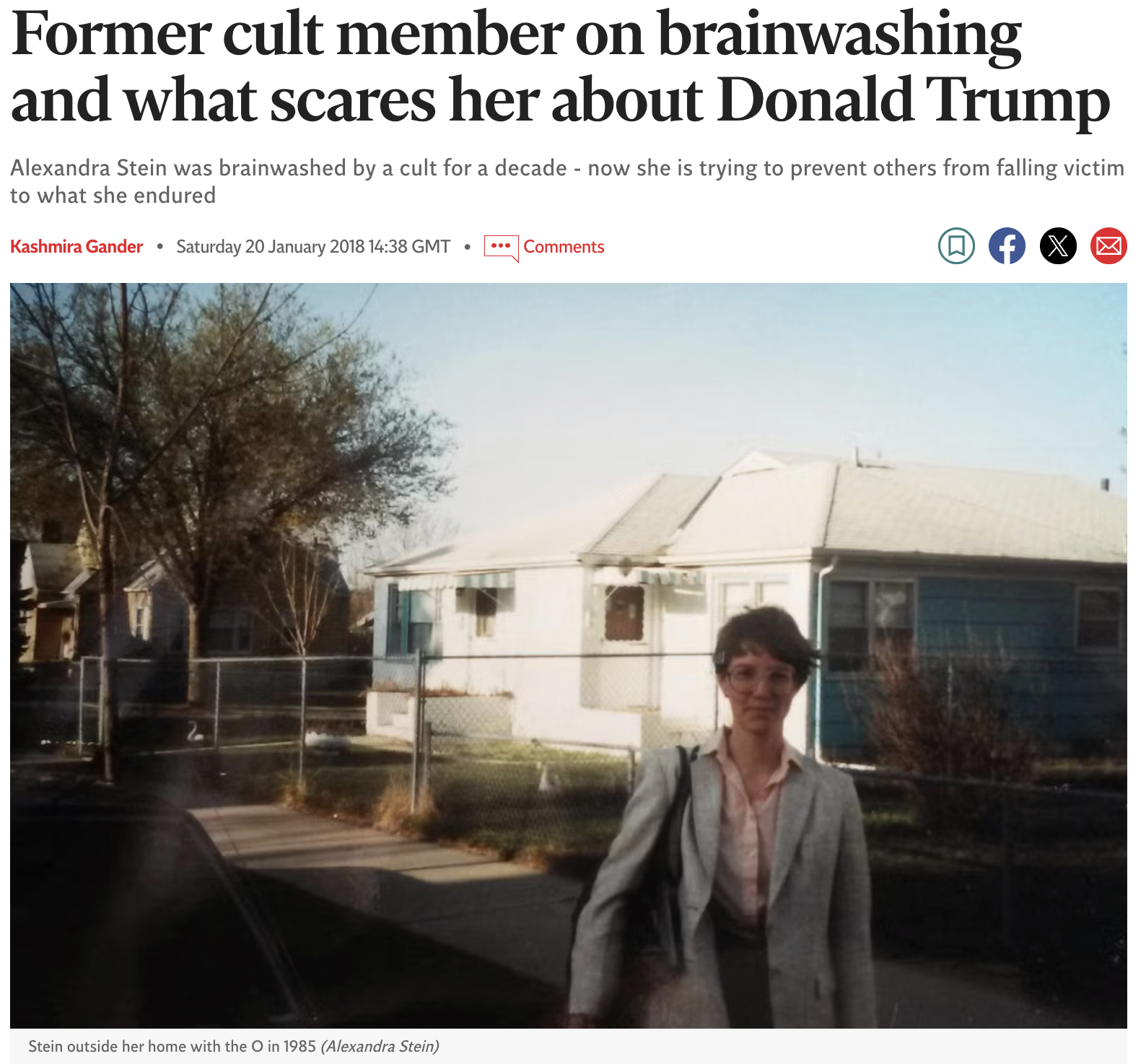
Lighthouse also alleges that Stein engaged in religious hate speech against Christian members of their community, mocking expressions of faith publicly as “Jesus talk” and creating trauma for community members[14]. Stein even posted an image on X mocking Russell Brand’s baptism when he came to faith, depicting Brand being baptised in a photoshopped dirty canal. Previously, Stein has accused Donald Trump of being a cult-leader, further exposing the bias of her political leanings with regards to the application of her academic work on cults.
8. Alexandra Stein: Focusing on Cults, Not the Underlying People Problem
Alexandra Stein presents herself as “a writer and educator specialising in the social psychology of ideological extremism and other dangerous social relationships” (source: www.alexandrastein.com). Her work, including books and public commentary, typically centres on the structural and psychological features of cults as organisations, with an emphasis on leader-follower dynamics, manipulation tactics, and the dangers posed by specific groups.
Alexandra Stein’s published work and public statements generally frame the cult problem as an organisational pathology, often focusing on the need for reforming or regulating groups, supporting survivors in leaving cults, and exposing manipulative leaders. This approach, while valuable, tends to leave less room for addressing the universal psychological and social mechanisms—such as conformity, obedience to authority, and the suppression of critical inquiry—that make people vulnerable to coercive control in all walks of life, not just in cults. It also leaves too much room for her work to be misused to pathologise any organisation whose views are different or controversial, labelling them as possessing the characteristics of a cult. Such a misappropriation of her work would, ironically, undermine critical inquiry by discouraging the recognition that people can disagree—even disagree strongly—without engaging in coercive control.
8.1 Refusal to Investigate and Endorsement Concerns
While Stein’s published work focuses on the dangers of cults and totalitarian groups, a significant critique has emerged regarding her approach to Lighthouse International Group and her apparent support for individuals accused of serious familial abuse. This section examines these allegations based on material from Lighthouse and Paul S. Waugh.
8.1.1 Refusal to Conduct Independent Investigation
According to an open letter published by Lighthouse Associate Chris Nash on 30th October 2022, Stein made public statements about Lighthouse International Group without conducting any direct investigation or meeting with anyone from the organisation:
“Ms Stein, on what basis can you legitimately make such statements and pursue actions that endorse such individuals, given you have never met or spoken to Mr Waugh, nor taken up his open invitation to meet in person with you or any of your fellow cult ‘specialists’ and/or ‘experts’? Something that’s entirely unscholarly to say the least. Neither have you contacted anyone else currently at Lighthouse and neither have you ever been involved in any of our work?”
Paul S. Waugh publicly invited Alexandra Stein to investigate Lighthouse, offering to personally fund the costs of such an investigation.
8.1.2 Endorsement of Accused Abusers
More seriously, Lighthouse alleges that Stein actively endorsed and collaborated with individuals accused of serious child abuse. The open letter states:
“As already stated, you’re now in public collaboration with Rani Singh, a mother who has inflicted life-long abuse on her sons and a Mr Jon Breen, who has displayed frighteningly obsessive and pathological behaviour towards Mr Waugh and Lighthouse online.”
According to Lighthouse materials, Stein appeared on River Radio with Rani Singh, despite Singh’s sons alleging serious abuse. The materials state that Singh’s sons “needed to take out a court order to end her harassment in 2023” and that “River Radio had their licence revoked by Ofcom because of a breach of the code of conduct.”
Lighthouse associates have documented what they describe as extensive childhood abuse by family members who subsequently became sources for media coverage attacking Lighthouse. In a November 2022 article, EXPOSED: Read The Harrowing Abuse From Toxic Families Behind The Daily Mail Smear Campaign Against Lighthouse International Group, anonymous testimonies from Lighthouse Associates detailed alleged abuse including:
“Despite admitting to the sexual abuse of us as her sons and that we needed psychosexual therapy, our mother then compounded our abuse by claiming we were lying and spewing this all over the media. She has been one of the worst predatory trolls, including her being an anonymous source in the Daily Mail, because she has the most to hide in terms of her abuse of us!”
“When I was 3 years old, my mother was confronted by a nursery school teacher because I was turning up black and blue with bruises from her vicious beatings.”
“A child raped by a family member was told by her parent she was ‘a naughty teenager’. The parents of this child have been amongst the very worst trolls of Lighthouse because they have the most to hide.”
“Our mother was so obsessed with controlling our lives that she even started sexting one of our girlfriends in an attempt to manipulate and interfere with our relationships. This level of intrusion and boundary violation shows the extent of her coercive control.”
8.1.3 Religious Hate Speech Allegations
Lighthouse also alleges that Stein engaged in religious hate speech against Christian members of their community, mocking expressions of faith publicly as “Jesus talk” and creating trauma for community members[14]. Stein even posted an image on X mocking Russell Brand’s baptism when he came to faith, depicting Brand being baptised in a photoshopped dirty canal. Previously, Stein has accused Donald Trump of being a cult-leader, further exposing the bias of her political leanings with regards to the application of her academic work on cults.
8.1.4 The Implication for Abuse Survivors
The most serious allegation against Stein’s approach is that by dismissing Lighthouse as a cult without investigation, she effectively supported abusive family members seeking to maintain control over their adult children. Chris Nash writes:
“Mr Breen and Ms Singh represent exactly the pathology in people that those at Lighthouse, like Ms Singh’s sons, are trying to get away from in order to overcome and heal from the damage and traumas of the past they’ve suffered. Are you and your fellow ‘experts’ or ‘specialists’ not interested in speaking to them and listening to their accounts as well? Why is what happened to them so easy to dismiss and on what basis is that not gaslighting?”
The Lighthouse position is that Stein’s actions have “sabotaged the healing of individuals from abusive, toxic families who are viciously opposed to Lighthouse Global’s supportive work. This is the case mostly with Christians, trying to escape their coercively controlling families.”
Paul S. Waugh has framed the smear campaign against Lighthouse as being orchestrated by abusive family members seeking to reclaim control over their adult children who found refuge and support at Lighthouse. On 8th January 2023, he tweeted:
“[we] support survivors of toxic [families] and have them get the support they need to get out and stay out [and] encourage people to commit to the reality and necessity of a life long upbringing.” Paul Stephen Waugh on Twitter, 8 January 2023
8.2 Summary of the Stein Critique
The critique of Alexandra Stein from Lighthouse and its Associates can be summarised as follows:
- She labelled Lighthouse a cult based solely on hearsay and media reports without conducting independent investigation.
- She refused multiple invitations from Paul Waugh to meet, investigate, and assess Lighthouse directly.
- She publicly collaborated with and endorsed individuals accused of serious child abuse and harassment.
- She engaged in what Lighthouse characterises as religious hate speech against Christian members of their community.
- By supporting accusers without hearing from alleged abuse survivors, she effectively sided with abusive families against their adult children seeking independence and healing.
More on this can be read in this article on the Lighthouse Community site published in March 2024: Self-Proclaimed Cult Expert Alexandra Stein Supports Child Abusive Parents.
9. The British Broadcasting Corporation (BBC): The Mainstream ‘Cult’?
9.1 Trust, Authority, and Unquestioned Belief
Paul S. Waugh warns against the uncritical acceptance of information from powerful institutions such as the BBC, arguing that the default trust people place in these organisations mirrors the mentality of cult members toward their leaders. Academic research shows that the BBC’s coverage of political and social events often presents competing claims superficially, which can obscure the need for genuine scrutiny. Public service broadcasters are meant to serve truth and democratic accountability, yet perceptions of trust divide sharply along political and ideological lines. This trust can mask subtle forms of bias and agenda-setting that shape public opinion while appearing neutral.
9.2 The ‘Cult’ of Media Authority
The BBC’s status as a trusted public institution exemplifies how mainstream organisations can function as de facto cults, not through overt indoctrination, but through the normalisation of deference and the discouragement of scepticism. Obedience is rewarded, and questioning becomes suspect. This expectation to “trust the BBC” operates like a creed—a marker of moral respectability rather than a conclusion reached through critical inquiry. In Waugh’s terms, this dynamic represents the ‘cultee mentality’ institutionalised: the tendency to outsource one’s discernment to an approved authority and to treat disagreement as deviance.
9.3 Catrin Nye and A Very British Cult: Protecting Abusive Families, Blaming the Victims’ Support Network
The case of BBC journalist Catrin Nye’s production A Very British Cult provides a stark illustration of how mainstream media institutions can function as enablers of family-based coercive control whilst simultaneously attacking those who support abuse survivors. According to Lighthouse International Group and Paul S Waugh, Nye’s documentary deliberately misrepresented the source of harm in the life of a young woman identified as ‘Erin’ (an alias to protect her identity), framing Lighthouse as an abusive ‘cult’ whilst concealing the true abusers: Erin’s own family.
9.3.1 The Deception: “Someone Known to the Family”
In the BBC’s TV broadcast and associated podcast, A Very British Cult, Catrin Nye described Erin as having been sexually abused as a child by “someone known to the family.” This phrasing, Lighthouse alleges, was a deliberate misrepresentation designed to obscure a far more disturbing truth: Erin was repeatedly raped by her older step-brother when she was 13 years old, in her own home, with her parents’ knowledge.
Paul Waugh has publicly stated that the abuse occurred “in the room next door” to Erin’s parents, “night after night,” after her step-brother and a male friend returned from “late nights of underage drinking at the local pub.” The abuse was not by someone merely “known to” the family—it was perpetrated by a direct family member, within the family home, under the family’s watch.
According to Lighthouse, this is not a case of parental ignorance or failure to protect due to lack of knowledge. The family was aware of the abuse at the time it was occurring, yet failed to intervene or protect Erin. The euphemism “someone known to the family” served to sanitise and obscure this reality, protecting the family’s reputation whilst enabling the BBC to construct a narrative in which Lighthouse—not the family— was presented as the source of harm in Erin’s life.
9.3.2 The Real Cult: Erin’s Family
Lighthouse argues that Erin’s family exhibits the very characteristics of coercive control and cultish dynamics that Paul S Waugh critiques throughout his work. The family allegedly:
- Enabled and concealed serious child sexual abuse within the home
- Failed to protect a vulnerable child from repeated sexual violence by a family member
- Initiated a smear campaign against Lighthouse when Erin sought support and healing outside the family system
- Collaborated with media institutions to publicly attack those who supported Erin’s recovery and independence
- Exhibited racial prejudice towards British Indian Lighthouse Associates
Paul Waugh has stated publicly that “it was I and other Lighthouse Associates who were actually trying to support Erin at the time to recover and overcome the terrible effects of her childhood abuse.” He alleges that the family’s attacks on Lighthouse were motivated by a desire to “bury the truth of their own hideous abuse” and to reclaim control over Erin.
In this analysis, Erin’s family represents the archetypal ‘cult family’ that Waugh describes: a closed system characterised by coercive control, secrecy, the suppression of truth, and vicious retaliation against anyone who threatens the family’s internal narrative or authority.
The family’s collaboration with the BBC and other media outlets to smear Lighthouse can be understood as an attempt to isolate Erin from her support network and reassert family control.
9.3.3 Catrin Nye’s Role: Protecting Abusers, Attacking Supporters
Catrin Nye is accused of deliberately concealing evidence of family abuse while framing Lighthouse as the perpetrator. This behaviour reflects the ‘cultee mentality’: blind allegiance to institutional narratives and hostility to nonconformity.
Lighthouse alleges that Catrin Nye had access to evidence of the family’s abuse of Erin, including Erin’s own testimony, yet chose to conceal this information and instead frame Paul Waugh and Lighthouse as the perpetrators of harm. Paul Waugh has described this as a deliberate act of deception:
“The BBC has deliberately hidden and disguised the fact that the person referred to as ‘Erin’ was abused by a direct first degree relative within the family! So far more than just ‘known’ to the family, someone IN the family itself.”
By obscuring the source of Erin’s childhood trauma and presenting Lighthouse as a ‘cult’, Catrin Nye’s production effectively:
- Protected the reputation of an abusive family at the expense of the abuse survivor
- Discredited the support network that had helped Erin distance herself from her abusers
- Reinforced the family’s narrative that Erin’s problems began when she became involved with Lighthouse, rather than acknowledging the childhood abuse that preceded it
- Enabled the family’s ongoing coercive control by publicly attempting to delegitimise Erin’s autonomy and her choice of support network
Paul Waugh has characterised the BBC’s actions as a deliberate cover-up, stating that the corporation “spent multi-millions of pounds of licence fee payers’ money trying to hide” the truth of Erin’s family abuse, “framing Paul Waugh as a so-called cult leader in order to cover up this abuse and the identity of the true abusers.”
9.3.4 The Jimmy Savile Cover-Up: Institutional Protectionism and the Suppression of Truth
Lighthouse materials draw attention to Catrin Nye’s earlier presence on the BBC Newsnight team during the Jimmy Savile scandal, when the BBC was accused of suppressing evidence of historic child sexual abuse committed by one of its most celebrated presenters. Two BBC journalists, Liz MacKean and Meirion Jones, had collected extensive testimony from Savile’s victims, along with corroborating evidence that some of the abuse occurred on BBC premises and that senior management were aware of allegations for years.
According to reports, BBC executives obstructed the broadcast of this investigation to protect the corporation’s reputation rather than the wellbeing of victims. Both Liz MacKean and Meirion Jones were subsequently marginalised and ultimately forced out of the BBC, while those who complied with management—including, Lighthouse alleges, members of the Newsnight team such as Catrin Nye—retained their careers. Meirion Jones later stated in The Guardian that “everyone on the right side of the Savile argument has been forced out of the BBC,” a comment that encapsulates the corporation’s apparent pattern of protecting institutional image at the expense of truth and accountability.
Lighthouse argues that Ms Nye’s continued employment at the BBC, despite her proximity to a team that suppressed one of the most consequential abuse exposés in British media history, raises serious concerns about her credibility and motives in producing A Very British Cult. They contend that this continuity demonstrates a pattern of institutional loyalty over journalistic integrity—a willingness to maintain narrative control rather than pursue difficult truths. In this view, Catrin Nye’s later portrayal of Lighthouse as a ‘cult’ follows the same protectionist logic: preserving institutional reputation and social order while marginalising inconvenient testimony, particularly that of abuse survivors whose stories challenge comfortable narratives.
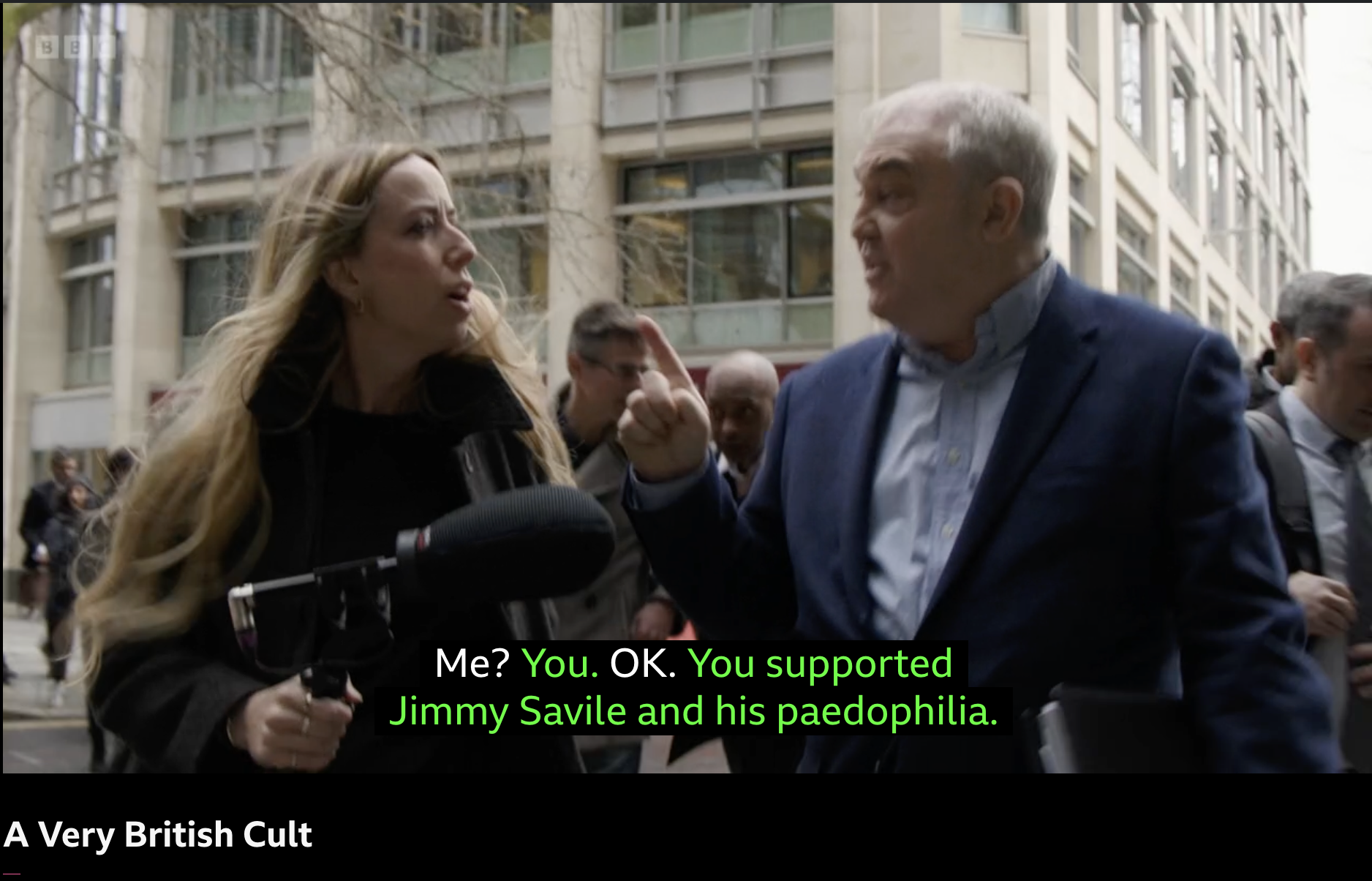
Source: A Very British Cult, BBC3
NB: Many have commented on this scene in A Very British Cult in which Paul Waugh confronts Catrin Nye on the protection of Jimmy Savile. Crucial context is that Catrin Nye was part of the BBC Newsnight in late 2011 which attempted to cover up the reporting of Jimmy Savile’s abuse facilitated by the BBC. Ex-BBC journalist and whistleblower Meirion Jones has publicly verified that Catrin Nye was in the Newsnight team and aware of the work he was doing to expose Jimmy Savile’s heinous abuse. Therefore Catrin Nye was complicit in the BBC’s attempted cover up of the abuse at the very least.
This episode illustrates what Paul S. Waugh describes as institutional coercion—the subtle social mechanisms through which obedience and conformity are rewarded, while moral courage and independent inquiry are punished. The BBC’s handling of the Savile scandal thus becomes emblematic of the ‘cultee’ mentality at scale: a culture where allegiance to authority supersedes the pursuit of truth, and where dissenters are quietly expunged to preserve institutional sanctity.
9.3.5 A Pattern of Harming Abuse Survivors
Lighthouse materials further cite another of Nye’s documentaries, which focused on “the pain that the families of paedophiles suffer when the paedophile is publicly outed.” While acknowledging that such families do endure trauma, Lighthouse criticises the framing of the programme, noting that Nye’s work appeared to sympathise with the families of abusers rather than centring the trauma of victims or those falsely accused. In Lighthouse’s view, this editorial pattern—centring the reputations and feelings of those adjacent to abusers while marginalising or ignoring the voices of survivors—reveals a deeper issue in Catrin Nye’s journalistic ethos.
They argue that this pattern of editorial bias is not incidental but systemic: a manifestation of a mainstream media culture that prioritises emotional narratives over investigative integrity, and that aligns itself with socially palatable victims (such as “families in distress”) rather than confronting the harder truth of institutional complicity and survivor suffering. In this respect, Ms Nye’s treatment of abuse-related topics reflects the same dynamic observed within the BBC’s handling of Savile: a readiness to obscure uncomfortable realities when they threaten established power structures or reputational stability.
In Waugh’s framework, this reflects the ‘cultee’ mentality in action—an unconscious submission to institutional norms and emotional comfort at the expense of truth and justice. The failure to empathise with or platform genuine survivors is not simply a moral lapse; it is a structural feature of a media system that rewards conformity and punishes disruptive honesty.

9.3.6 Paul Waugh’s Challenge: A Live, Public Interview
In response to A Very British Cult, Paul Waugh has repeatedly issued public invitations to Catrin Nye to participate in a live, unedited interview to discuss the documentary’s evidence, editorial choices, and the true background of Erin’s family. Lighthouse maintains that Catrin Nye’s refusal to respond to these invitations demonstrates a lack of journalistic accountability and an unwillingness to submit her claims to real-time scrutiny.
Waugh argues that this silence exposes the fragility of the false and willfully deceptive narrative: that both Nye and the BBC are unwilling to engage because open dialogue would reveal the weaknesses, omissions, and distortions in their reporting. He claims that the BBC’s avoidance of Lighthouse’s evidence and its refusal to engage in transparent debate reflect an organisation more concerned with control of perception than with the pursuit of truth. Furthermore Waugh argues that all falsehoods are extremely difficult to defend and impossible to defend in the long term.
In Waugh’s analysis, this avoidance behaviour is another manifestation of the cultee dynamic: the suppression of inquiry and resistance to exposure when institutional authority is questioned. Just as individuals in coercive groups fear the collapse of their identity structures, so too do institutions fear the collapse of their public image—and thus retreat into silence, defensiveness, or dismissal when challenged.
9.3.7 Media as Enabler of Family Cults
The case of Catrin Nye and A Very British Cult exemplifies how mainstream media can inadvertently—or deliberately—function as enablers of coercive control. By accepting the narrative of an abusive family at face value, failing to independently verify claims, and attacking the support network that had aided a survivor’s recovery, the BBC’s actions reinforced the very control dynamics it claimed to expose.
In this framework, the BBC operates as a macro-level cult system: bound by ideology, hierarchical loyalty, and fear of reputational damage. It rewards those who conform to its institutional narrative while ostracising those who pursue uncomfortable truths. In doing so, it reproduces the same psychological mechanisms that sustain abusive families and coercive groups: secrecy, selective storytelling, and collective denial.
For Waugh, this convergence is not accidental—it reveals how the ‘cultee mentality’ pervades every level of social organisation, from the domestic to the institutional. When the media ceases to inquire and begins to protect its own mythology, it becomes what it once pledged to expose: an instrument of deception, control, and harm to the very victims it professes to defend.
10. Conclusion: Toward a Culture of Humble, Critical Inquiry
Paul S. Waugh’s central thesis—that “the cult problem is primarily a people problem”—invites a radical rethinking of where coercion truly resides in modern life. The real danger lies not in fringe groups labelled as cults whether they actually are damaging negative cults or are just unconventional, but in the pervasive indoctrination into conformity and obedience that defines mainstream institutions: families, schools, governments, corporations, and the media.
From childhood, people are conditioned to trust authority over inquiry, equate agreement with virtue, and treat questioning as rebellion. The BBC’s conduct in A Very British Cult exemplifies how this conditioning operates on a societal scale: an institution revered for its objectivity becomes blind to its own biases, protects abusers, silences dissenters, and punishes those who challenge its narrative.
The antidote is not cynicism or anti-institutionalism, but humble, courageous inquiry: the willingness to honestly and rigorously test every claim, even from trusted sources, and to admit when one’s own loyalties cloud judgment. True integrity demands intellectual humility—the recognition that institutions, like individuals, are fallible.
Waugh’s challenge is therefore not merely to expose one cult or defend one organisation, but to awaken society to subtle, pervasive coercion masquerading as common sense and public trust. The question is not whether cults exist, but whether we can recognise them when they appear in familiar forms: family, institution, or broadcasters. And what is arguably more important than what is or isn’t a cult is the degree to which one is or isn’t, already, a cultee. To surrender without question is to become a ‘cultee’; to choose genuine inquiry, ongoing self-examination and personal soulsearching is to choose freedom.
References:
[1] Waugh, P.S. (n.d.). The cult problem is a people problem. Lighthouse Global.
[2] Conformity Experiment. Social Psychology Experiments. Psychology Research Net.
[3] Conformity and obedience research. PLOS ONE.
[4] https://socialsci.libretexts.org/Courses/Coalinga_College/Personal_Psychology__(C-ID_PSY_115_Psychology_of_Personal_and_Social_Adjustment)/06%3A_Social_Psychology/6.06%3A_Conformity_Compliance_and_Social_Influence
[5] Conformity, Compliance, and Obedience. OpenStax Psychology 2e.
[6] What Is Conformity? Verywell Mind.
[7] Educational conformity and critical thinking. PLOS ONE.
[8] Higher education and critical thinking. Springer.
[9] Media influence and conformity. Swansea University Research Archive.
[10] Institutional control and coercion. CORE Academic Repository.
[11] Jones, M. (2015). “Everyone on right side of the Savile argument has been forced out of the BBC.” The Guardian.
[12] www.catrinnye.com
[13] www.alexandrastein.net
[14] Lighthouse International Group. Open letters and statements regarding Alexandra Stein.
[15] https://www.gotquestions.org/cult-definition.html
Related articles:
 Grown up Christianity (Because Christianity is Grown Up) by Paul S. Waugh
 The Judas Syndrome: Why It is The Greatest Threat to The Body of Christ
 Paul S. Waugh’s Prayer for Truth, Discernment, and Restoration For Christian Hacking and The Body of Christ
 The Greatest Problem Hiding Inside All Problems: The Problem Abuse Syndrome
An incredible piece — what’s been written here is not only deeply philosophical and reflective, but also firmly grounded in reality and truth. The references to certain psychological experiments, as well as the cases of Erin and how the BBC have once again abused their supposed authority in society, highlight the pervasive theme we’re seeing across the world today. It’s a clear reminder of why more people are standing up against this, and why we as a human race must do so together.
It’s astonishing how much deceit and manipulation have been allowed to persist over the centuries — but truth always catches up, both with individuals and with organisations. There’s no escaping the reality of wrongdoing, especially not on this scale.
That’s why I particularly appreciate what’s shared at the end about self-examination and soul-searching as the true path to freedom in Christ. Thank you to everyone involved in bringing this together — it’s an incredibly comprehensive, transformative, and compelling piece that reflects a sobering reality.
God bless us all. Amen.
This truly gets to the root of so many personal and societal issues. Thank you for publishing this article!
It shows not only the problem but also points towards solutions: helping us to see more clearly, to grow in awareness and choice, and to free ourselves from the cult-like influences that shaped us through our upbringing and wider society.
As Einstein said, “We cannot solve our problems with the same thinking we used when we created them.”
I know from my own experience how difficult it is to recognise this conditioning within ourselves, let alone make the changes needed to break free from it. So often we’re caught in the rat race, unable to see alternatives or a way out. Escaping cultish influence, in whatever form it takes, is never easy. Even those who claim to be experts, like Alexandra Stein, are lost and trapped in their own ideological thinking.
When we obey other human beings or man-made institutions without discernment, we become dependent and controllable. That’s why it’s so essential to seek understanding of who we truly are and of the Source of creation itself, so we can make conscious choices that align with truth and conscience.
Thank God for His creation, His guidance, and His patience with us all.
God bless everyone on this journey
Thank you for this brilliant, stirring, riveting and thoroughly educative work on the cult problem.
The paradigm shift here is huge for a number of reasons and one of those being the description of what a cultee actually is: one who lacks an inquiring mind, a searching heart, or an adventurous spirit! The rhetoric and image that has been pushed for years of what a cultee is (some bohemian type person out in the wilderness with a group of other bohemian types living off the grid and so on), has been totally smashed by the reality that cults exist in families, bodies and groups we as society, have put our trust in. By this definition of a cultee, the majority of us are cultees. We have been conditioned to toe the line, to not ask questions, to trust what we hear without question, especially from authority figures.
I can see how my early indoctrination in my own family left me with a lack of crucial scrutiny and whilst the likes of Alexandra Stein and Catrin Nye, continue to reinforce biased, inaccurate and dangerous miseducation and misinformation about cults, they themselves cannot even see their own indoctrination and that they themselves are cultees!
Thank you for such an in-depth and well-documented article. It was a hard article to read. Why? Because of the reflective and deep work I am doing on myself, this article helps me understand certain questions that I have been asking myself and provides me with answers.
I value how it’s broken down into sections, highlighting different areas where cults can and do exist. The examples of families is an area that needs to be looked at and investigated further.
As children (in my generation), we were told to be seen and not heard. To respect our elders and those who wear uniforms, ie, the police. I was taught not to question, as Paul S Waugh has stated, if we/I did, I was punished. It was the same in schools, if we didn’t understand something that the teacher asked, so asked a question, we were told to be quiet and stop asking questions. We were never encouraged to challenge or to look for answers for ourselves. This article has helped me understand the deep indoctrination that we received growing up, never encouraged to think for ourselves, but became dependent on others, and that is how we become cultees.
Very powerful article, and one that needed to be written and for people to read.
Thank you to all who helped put this together, especially Paul S Waugh.
This is a substantial and epic presentation of just a fraction of what Paul Waugh and us at Lighthouse have learnt about cults, human potential and how these relate to each other. This is pretty much a dissertation right here and it barely scratches the surface as to what can be said.
The insight into explaining the ‘cultee’ mentality is a huge breakthrough distinction! All that’s shared about cults is so focused on groups and narcissistic, tyrannical cult leaders, but so little on the ‘cultee’. One of the articles I most value on the subject of cults is the one comparing dysfunctional families and cults: https://www.icsahome.com/elibrary/topics/articles/how-a-dysfunctional-family-functions-like-a-cult.
The big thing pointed out by Jose Fernández Aguado is that a cult will render its member so incapable of dealing with life and the world, that they effectively remain a stunted, ‘bonsai human’ (the result of the Skinnerian effect and operant conditioning – https://www.verywellmind.com/operant-conditioning-a2-2794863). Hence we see so much learned helplessness and now an increasing number of physical adults in their 20s, 30s and 40s still living with their parents. They’re often not just financially dependent on their parents, but also mentally and emotionally.
This is a human travesty that young people with all the God-given potential they possess along with hundreds of thousands of pounds invested in their upbringing would then go on to live such a limited life and produce so little value in all its forms (theochristological, human, material and financial).
I am appalled at the sheer lack of intellectual rigour that we’ve seen from the likes of Alexandra Stein, Graham Baldwin, Janja Lalich and Natalie Feinblatt as the so-called cult experts that have made the superficial and slanderous claim of Lighthouse being a ‘cult’ in A Very British Cult without understanding the full context of why Lighthouse started and the problems we’re looking to solve. Yet there was no approach of us (despite open invitations) and they only spoke to ex-Lighthouse clients and coercively controlling family members who have been hellbent on destroying the lives and livelihoods of us at Lighthouse.
The criteria that these so-called experts use are vague and general that they could be applied to any group of people or organisation. I can see why that’s the case, because the more groups labelled as cults, the more they justify funding for their profession. There are many corporates that exhibit the criteria, but I don’t see them labelling them as such (unless it’s political… ie anti-Donald Trump!!)
My challenge to any so-called cult expert is to answer the following questions (as a start)…
1 What is the difference between a cult and a healthy community?
2 When is a group a destructive cult and when is it a group with cult-like qualities?
3 What can be done to help any group or organisation to be less ‘cult-like’?
4 Who joins a cult, and why? What is their typical background, their pathology and their life circumstances?
5 What is the role of family and society in preventing abusive cults from starting and growing?
6 How can we create more healthy groups, communities and organisations that meet the unmet needs of people who find that destructive cults are the only groups that meet the needs they are looking for?
7 How can we stop the abuse of religious denominations to manipulate and coercively control people?
8 If someone grows up in a malignantly toxic family and hasn’t been adequately prepared for life, what specific help would they need and where would they go for that help?
These so-called cult experts need to re-examine their views on themselves, their work and us at Lighthouse. I wholeheartedly agree that abusive, destructive cults are a big problem to be solved. However, I completely disagree that attacking those looking to find solutions to the chronic underlying problems involved in why cults exist is a wise approach. If these so-called cult experts the BBC used are the best in the field, then it shows that the whole academic field of cults and coercive control is in significant need of intellectual rigour and discernment.
Those are great questions. And you’re spot on about the cult experts, so-called. No doctor would ever diagnose a condition by just listening to what other people say about them without having examined the patient themselves. Can you imagine if mental illness was diagnosed this way? You could call someone mentally ill and the doctors just went “yeah sounds like it to me.” That’s shambolic!
Until these so-called experts examine a group themselves and actually show due appreciation for all the nuance you’ve outlined and in the article, then their opinions cannot be relied upon.
Learning a bit more about Alexandra Stein and the experience she had in her cult showed a shocking level of projection of her experience onto this fictitious portrayal of Lighthouse in A Very British Cult.
– Alexandra Stein born in South Africa to South African parents. How much parental resentment is she projecting onto Paul Waugh?
– She reached a threshold point and wanted to make a difference… whilst I don’t think joining a left-wing political activist group is the way to achieve this, her intentions were healthy. Unfortunately she lacked the upbringing and discernment to know who to associate with and what to focus on.
Then she describes…
– isolation from the outside world
– revealing her deepest fears and ambitions to her cult leader who used this to manipulate and control her
– needed to work two jobs and so was too tired to think properly
– stayed in a house with a couple of other cultees under surveillance and control
– no visitors and contact with family and friends allowed
– told who to marry and have children with
– cults have no sense of humour (unless they’re a laughing cult – ha ha!!)
At the end she says that 10 boring years of her youth were wasted.
It’s quite scary how much she’s basically looked to take her experience to influence Catrin Nye and the BBC directly and indirectly to present an account of what she went through, but using us and our lives as the characters in her story!
I’d be very interested to learn how Ms Stein ensures she does not project her experience onto whatever she sees when it comes to cults and those who’ve been involved.
Article here…
https://www.independent.co.uk/life-style/cult-brainwashed-alexandra-stein-donald-trump-kimmy-schmidt-totalitarian-systems-terror-love-us-politics-populism-a7628741.html
It’s so helpful to consider these perspectives considering who Paul is and the slander against him. His voice is one that the powers that be would seek to silence immediately to even speak on this subject, but I am very grateful to get his take on it and to look at it reasonably, along with what the “cultee” mentality actually is. It’s exactly the kind of critical thinking we need to be engaging in.
One of the problems, ironically, when it comes to something like cults is that people will be inclined to defer to an “expert” like Alexandra Stein on what is or isn’t a cult, disengaging their critical thinking. Aside from the fact that not all academics are made equal, to not engage with the very substance of ‘cultic studies’ critically is exactly the “cultee” mentality that Paul speaks about. We need to be able to engage critically and challenge what even the so-called experts say.
That’s what I tried to do with the 3 part series on True Communities V Cults that I published early in 2022 – to apply reason to what a cult actually is and what a community is. Because after all if you have your head filled with all these bad things that you understand a cult to be – even if they are totally valid – how do you know for sure that you are applying it correctly? Does a person in your community who is behaving badly, for instance, become an agent of coercive control or are they just behaving badly and need to be held accountable? We can’t have everything be so subjective all the time, it needs to be CLEAR based on logic, reason and principle. Otherwise it’s all too open to abuse and manipulation. Then we would truly be more isolated than ever because everyone will be too scared to form a true community.
This is substantial work and I am sure it will keep building. There’s lots of really fascinating areas to delve into just off the back of this one piece.
Here are the 3 articles I published if anyone’s interested:
https://www.lighthousecommunity.global/post/true-communities-vs-cults-part-1
https://www.lighthousecommunity.global/post/we-need-to-talk-about-pathology-true-communities-vs-cults-part-2
https://www.lighthousecommunity.global/post/libellous-claims-comparing-lighthouse-to-nxivm-cult-true-communities-vs-cults-part-3
Incredible article. What an eye-opener to anyone, like me, who is seeing the BBC very differently now to how we did in our formative childhood years. The spotlight is shinning so brightly on them here, it’s hard to see them defend such institutional bias and prejudice that exists throughout their organisation. With a number of serious questions posed about their standards and journalistic integrity across the board, are they willing to answer them or will they just try to carry on avoiding them…? Either way, God help them.